

Why Your Child’s Study Table Matters More Than You Think
I spent three years recommending children’s furniture to Indian parents before I understood what actually goes wrong at homework time. The problem is almost never the child’s motivation or the subject. The problem is almost always the physical setup.
A child hunched over a dining table with feet dangling, neck bent forward, competing for space with a water jug and last night’s dishes, that child cannot focus. Not because they are lazy, but because their body is uncomfortable, their space is not theirs, and every physical signal tells them this is a temporary inconvenience, not a place of work.
A properly chosen study table for kids changes that signal completely.
This guide covers every decision you need to make before buying: which type suits your room, what height fits your child’s age, which material handles Indian climate conditions best, how ergonomics works in practice, what vastu shastra says about study table placement, and what your budget actually gets you across every price tier. By the end, you will have everything you need to buy once and buy right.
A study table is one type of kids study table, this guide covers the full category so you can find the right fit for your child’s age, room, and study habits.
What Is a Study Table for Kids — and Who Actually Needs One?
A study table for kids is a dedicated work surface sized and designed for a child’s body, study habits, and room. It differs from an adult desk in surface height, dimensions, safety features, and storage design. A good kids study table creates a physical boundary that tells the child: this space is for focused work.
Not every child needs the same type of study table. A 4-year-old doing colouring sheets has different needs than a 10-year-old attending online classes with a laptop, textbook, and notebook open simultaneously.
What others miss about this definition: Most buying guides treat “study table for kids” as a single product. In practice it covers at least four distinct product types serving four different buyer situations. Understanding which category your child falls into is the first and most important step, before you look at a single price or brand.
Who Is This For — Use Cases by Age, Room, and Study Situation
Before comparing types or prices, identify which situation matches your child. This shapes every other decision.
Small Rooms and 1–2 BHK Apartments
In most Indian urban apartments, the child does not have a dedicated bedroom with generous floor space. A foldable or wall-mounted study table is the honest answer here, it clears the floor when not in use and keeps the room functional. Expecting a large fixed desk to work well in a 10×10 room creates a furniture problem, not a study solution.
See More: See our guide to foldable study tables for kids]
Toddlers and Young Children (Ages 3 to 6)
Young children at this stage need a study table that is safe, lightweight, visually engaging, and easy to clean. Storage is secondary. Ergonomic precision is secondary. The primary job of a study table at this age is to create a designated spot for drawing, colouring, and early reading that is scaled to the child’s body. A table that feels like theirs, at their height, matters more than any feature list.
School-Age Children Studying on a Desk (Ages 6 to 12)
This is the largest and most important buyer group for a study table for kids in India. The child has homework, textbooks, notebooks, and stationery to manage simultaneously. An adjustable height table with at least one storage drawer becomes the practical minimum. An ergonomic chair pairing becomes important from age 6 onwards.
Teens and Online Learners
From age 12, study sessions extend in length and complexity. Online classes require laptop space, correct screen distance, and adequate lighting setup. The study table at this age functions more like a home office workstation. Surface width becomes critical, 90 cm minimum for a teen who runs a laptop alongside physical books.
Types of Study Tables for Kids — A Complete Comparison
Understanding the five main types before you shop eliminates most buying mistakes I see Indian parents make.
1. Fixed Height Study Tables
A fixed study table sits at one permanent height and does not adjust. It is the most affordable and most widely available type in India.
- Best for: Children aged 3 to 6 years, where a precise ergonomic fit matters less
- Pros: Stable, simple structure, very affordable, easy to find across all Indian cities
- Cons: The child outgrows it within 2 to 3 years; replacing furniture every few years costs more than buying adjustable initially
- Price range in India: ₹800 to ₹3,000
2. Height-Adjustable Study Tables
A height-adjustable study table raises or lowers the surface using a lever, knob, or pin mechanism. This is the type I recommend most confidently to parents of school-age children.
- Best for: Children aged 6 to 12 years who are actively growing
- Pros: Grows with the child across multiple years, supports correct posture at each stage, saves replacement cost
- Cons: Slightly higher upfront price; quality of the adjustment mechanism varies significantly — test it before buying
- Price range in India: ₹2,500 to ₹8,000
What others miss: The adjustment mechanism quality determines whether an “adjustable” table actually gets adjusted. Cheap pin-and-hole mechanisms wobble at the locked position and parents stop adjusting them after the first month. Look for a lever or knob system with a firm, stable lock. A slightly higher price for a reliable mechanism is worth every rupee.
3. Foldable and Wall-Mounted Study Tables
Foldable study tables collapse flat when not in use. Wall-mounted versions fold against the wall. Both solve the space problem in urban Indian apartments.
- Best for: Small rooms, homes where the study area doubles as a play or sleep space
- Pros: Saves significant floor space, creates a clean room during non-study hours
- Cons: Limited surface area, not suitable for children who need to spread multiple books simultaneously
- Price range in India: ₹1,200 to ₹4,500
Note on wall-mounted versions: they require drilling into the wall. Check your rental agreement before ordering. Freestanding foldable models need no installation and are more practical for rented homes.
4. Study Table and Chair Combo Sets
Combo sets bundle a study table and matching chair sized as a pair.
- Best for: Parents who want a complete ergonomic setup in one purchase
- Pros: Chair and table heights are engineered to work together, bundled value, often includes storage
- Cons: If one piece wears out before the other, replacing just the worn piece to match the surviving one can be difficult
- Price range in India: ₹2,000 to ₹7,000
5. Themed and Cartoon Study Tables
These feature designs based on popular characters, Doraemon, Spiderman, Disney themes, and similar.
- Best for: Children aged 3 to 7 who need a motivation boost to sit at a study table
- Pros: Creates enthusiasm, makes the table feel like the child’s own special space
- Cons: Design preferences change faster than the table wears out; a 9-year-old will often want nothing to do with the Doraemon table they loved at age 5
- Price range in India: ₹1,500 to ₹4,000
| Feature | Fixed | Adjustable | Foldable | Combo Set | Themed |
|---|---|---|---|---|---|
| Useful lifespan | 2–3 years | 5–8 years | 4–6 years | 4–6 years | 2–4 years |
| Space required | Medium | Medium | Minimal | Medium | Small-Med |
| Ergonomics | Basic | Excellent | Basic | Good | Basic |
| Price (India) | ₹800–₹3,000 | ₹2,500–₹8,000 | ₹1,200–₹4,500 | ₹2,000–₹7,000 | ₹1,500–₹4,000 |
| Best age | 3–6 yrs | 6–12 yrs | Any | 4–10 yrs | 3–7 yrs |
[IMAGE: Five types of study tables for kids side by side comparison | ALT TEXT: types of study table for kids India fixed adjustable foldable]
How to Choose the Right Study Table — 7 Factors That Actually Matter
This is the decision section most buying guides skip. They show you products without helping you narrow down to the right one for your specific situation.
Factor 1 — Your Child’s Current Age and Height
Age is the single most important buying factor for a kids study table in India. Match the table height to where the child’s elbow sits when seated, that is the correct surface height. The table below gives you the precise numbers.
| Age Group | Child Height (cm) | Ideal Table Height | Chair Height Needed |
|---|---|---|---|
| 3–5 years | 90–105 cm | 45–52 cm | 26–30 cm |
| 6–8 years | 105–125 cm | 52–58 cm | 30–35 cm |
| 9–12 years | 125–145 cm | 58–72 cm | 35–42 cm |
| 13+ years | 145 cm+ | 65–75 cm | 40–46 cm |
Factor 2 — Available Room Space
Measure the floor area before you browse. A 90 cm x 50 cm table needs at least 150 cm of clearance around it for the child to move comfortably. In rooms under 100 sq ft, a foldable option is not a compromise, it is the correct choice.
Factor 3 — Fixed vs Adjustable
If your child is under 6, a fixed table is fine, they will grow out of any table at this age. From age 6 onwards, buy adjustable. The cost difference of ₹500 to ₹1,500 between a fixed and adjustable table at the mid-range level pays back within the first year of extended use.
Factor 4 — Storage Needs
A 5-year-old needs a pencil tray. A 9-year-old needs a drawer for stationery, a shelf for reference books, and a surface clear enough to open three notebooks at once. Think about what your child actually puts on the table during a study session, then verify the table you are considering can hold all of it without clutter.
Factor 5 — Material Preference
Wood and MDF outlast plastic for school-age children in Indian conditions. Plastic is correct for children under 6, lightweight, easy to clean, replaceable. For ages 6 and above in Indian climate, the humidity and heat that affect material longevity make wood or metal-MDF combinations a better investment. More on this in the materials section below.
Factor 6 — Laptop and Tablet Compatibility
If your child attends online classes or uses a laptop for assignments, confirm the table surface is at least 90 cm wide and 50 cm deep. Anything smaller forces the child to choose between the laptop and the notebook, which means the notebook ends up on the floor.
Factor 7 — Style and Theme
This factor belongs in the buying decision, not as an afterthought. A 5-year-old who loves their Doraemon table and actually sits at it willingly provides more academic benefit than a perfectly ergonomic desk they avoid. For older children, let them choose the colour or finish, ownership increases usage.
► MY POV: In my experience, parents focus almost entirely on Factors 1 and 5 and skip Factor 7 completely. The most ergonomically correct study table for kids does no good if the child refuses to sit at it. For children under 8, I recommend involving the child in the final choice between two pre-screened options. Give them the decision between the options you have already approved, they feel ownership, you keep control of quality.
Study Table Materials Compared — Wood, Plastic, MDF, and Metal (India Context)
Material is the dimension where Indian buyers get the least useful information. Most guides say “wood is better” without explaining why that is specifically true in India.
Solid Wood Study Tables
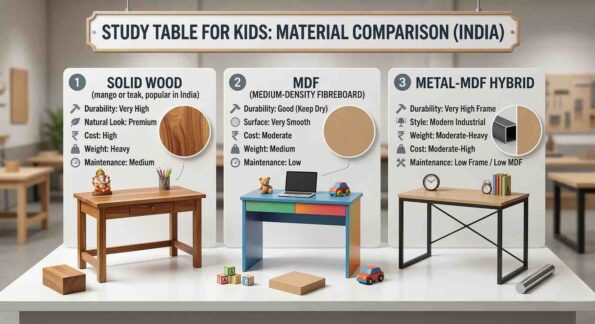
Solid wood, sheesham, teak, or rubber wood, is the most durable material for a kids study table in India. The key reason is climate. Indian homes experience a wide humidity and temperature range across the year. Solid wood expands and contracts with humidity changes without structural damage. A quality wooden study table for kids, maintained with occasional wax or polish, lasts 10 to 15 years.
The trade-off is weight and price. Solid wood tables start at approximately ₹4,000 and can reach ₹15,000 for full-featured pieces. They are heavy and difficult to move frequently.
Best for: Long-term investment buyers, children aged 8 and above, homes with consistent humidity levels.
MDF Study Tables
MDF (Medium Density Fibreboard) dominates the Indian market in the ₹1,500 to ₹5,000 range. It gives a smooth, uniform surface, takes paint and laminate well, and is significantly lighter than solid wood.
The weakness in Indian conditions is moisture. MDF swells irreversibly when it absorbs water. Keep MDF tables away from windows that take in monsoon rain, do not place wet glasses directly on the surface, and avoid placing them in kitchens or near bathrooms. In coastal Indian cities with high ambient humidity, MDF degrades faster than in drier northern climates.
Best for: Budget-conscious parents in low-humidity regions, children aged 5 to 10 years.
Plastic Study Tables
Plastic is the lightest and cheapest option. It cleans easily, comes in bright colours, and costs almost nothing to replace.
The practical limitation: in Indian summer conditions near windows, which is where study tables often sit for natural light, lower-grade plastic warps and discolours within one to two seasons. For heavy daily use with textbooks, water bottles, and elbows pressed during writing, plastic degrades visibly within 18 months.
Best for: Children under 6 years, temporary setups, very tight budgets under ₹1,500.
Metal Frame with MDF Top
Metal-framed tables with an MDF or board surface combine structural stability with an affordable top surface. The metal frame provides the rigidity and longevity; the MDF top provides the work surface.
This combination is the most common construction in height-adjustable study tables because the metal frame handles the mechanical stress of repeated adjustments better than wood joints.
Best for: Adjustable-height models, stability-focused buyers, modern aesthetic preferences.
| Material | Durability | Price Range | India Climate Suitability | Best For |
|---|---|---|---|---|
| Solid Wood | Excellent | ₹4,000–₹15,000 | Best — humidity resistant | Long-term, ages 8+ |
| MDF | Good | ₹1,500–₹5,000 | Fair — avoid direct moisture | Mid-range, ages 5–10 |
| Plastic | Fair | ₹500–₹2,500 | Fair — fades in heat | Under 6 yrs, budget |
| Metal + MDF | Very Good | ₹2,500–₹8,000 | Good — check for rust in coastal areas | Adjustable models |
What others miss: No competing guide mentions the coastal India factor. In cities like Mumbai, Chennai, Kochi, or Visakhapatnam, ambient humidity is significantly higher than in Delhi or Jaipur. A metal-frame table in a coastal home needs a rust-resistant powder coat finish, confirm this on the product listing before buying.
Ergonomics for Kids — Why Posture Starts at the Study Table
Poor posture during childhood is not just uncomfortable in the moment. Paediatric physiotherapists consistently point to ill-fitted children’s furniture as a leading cause of early back and neck pain in school-age children. The good news is that correct ergonomics is not complicated, it comes down to three measurements.
The 90-Degree Rule
When your child sits at the study table, three angles should each be at or near 90 degrees: the angle at the knee, the angle at the hip, and the angle at the elbow. This is the single most useful ergonomic rule for a kids study table in India, and almost no competing guide explains it this clearly.
- Knee at 90 degrees: Feet rest flat on the floor. Dangling feet create tension in the lower back and thighs during long study sessions.
- Hip at 90 degrees: The child sits upright, not slouched. The chair back supports the lower spine without pushing the child forward.
- Elbow at 90 degrees: The table surface sits at the height of the child’s elbows when arms hang naturally. This eliminates hunching.
If all three are correct, the child’s back, neck, and wrists remain in a neutral, unstressed position for the duration of the study session.
Study Table Height Chart by Age — India Edition
| Age Group | Typical Height | Correct Table Height | Notes for Indian Homes |
|---|---|---|---|
| 3–5 years | 90–105 cm | 45–52 cm | Floor beds (diwan) common, if child studies on bed, lap desk at 30–35 cm |
| 6–8 years | 105–125 cm | 52–58 cm | Most common school-homework age, adjustable table strongly recommended |
| 9–12 years | 125–145 cm | 58–72 cm | Laptop use begins, screen distance 40–50 cm from eyes |
| 13+ years | 145 cm+ | 65–75 cm | Adult dimensions; standard office desk may now be appropriate |
India-specific note: Many Indian homes use divans or low platform beds rather than raised European-style beds. If your child studies at a bed-level surface rather than a freestanding table, the height calculation changes. A lap desk for bed study should sit at approximately 28 to 35 cm to maintain the 90-degree elbow angle when the child sits cross-legged or with legs forward.
How to Set Up an Ergonomic Study Station at Home
Step 1: Set the chair height first. The child’s feet must sit flat on the floor with knees at 90 degrees. This is the base for every other measurement.
Step 2: Set the table height to elbow level. With the child seated correctly in the chair, the table surface should meet their elbows when arms hang naturally at their sides.
Step 3: Set screen or book distance. For physical books, 35 to 40 cm is the recommended reading distance. For screens, 40 to 50 cm with the top of the screen at eye level or just below.
Step 4: Check lighting. Natural light should come from the side, left side for right-handed children, right side for left-handed children. A dedicated study lamp reduces eye strain significantly during evening study sessions.
► MY POV: The ergonomic setup step is the one most Indian parents do once and never revisit. I check my children’s study station heights every six months, growth happens faster than you expect, and a 9-year-old at the correct height in January is often sitting hunched by June. It takes two minutes to check and adjust. Those two minutes prevent months of accumulated posture issues.
Source: Crazy Smart Trips
Safety Features — What to Check Before Buying
Safety is the dimension most online buying guides treat as a legal formality. In practice, it is the most important dimension for children under 8, and it has specific requirements for Indian products.
6 Safety Features Every Kids Study Table Must Have
- Rounded or bevelled edges: No sharp right-angle corners at child head or body height. Run your hand along every edge of the table before purchasing in-store, or look for specific “rounded edge” or “bevelled edge” language in online listings.
- BIS-certified non-toxic finish: The paint, lacquer, or laminate coating must not contain harmful chemicals. In India, look for BIS (Bureau of Indian Standards) certification on the product. For children under 8 who may touch surfaces and put hands near their mouths, this is non-negotiable.
- Anti-slip rubber feet: The table must not shift on tile or marble floors, the most common flooring in Indian homes — when the child leans on it. Test this specifically; many cheap tables slide freely on smooth surfaces.
- Stable base on soft surfaces: If the table will be used on a rug or carpet, the base must remain stable without tipping. Wide-base designs with four corner legs outperform narrow single-pedestal designs on soft surfaces.
- Minimum weight capacity of 5 kg: Textbooks, a laptop, a water bottle, and stationery together weigh more than parents expect. Verify the rated weight capacity on the product specification, not the marketing description.
- No protruding screws or bolts: Check all assembly points. Self-assembly study tables sometimes leave bolt ends exposed on child-contact surfaces. This is avoidable at the purchase stage.
Safety Red Flags — What to Avoid
Avoid tables that arrive with a chemical smell. A strong formaldehyde or paint smell from an MDF or laminate table indicates inadequate curing of the finish. This is a genuine air quality concern in a child’s study space. A quality table has little to no smell upon unboxing.
Avoid single-bar adjustment locks on adjustable tables. These create a single point of mechanical failure. If the lock fails during use, the table surface can drop suddenly. Look for dual-point locking mechanisms or continuous screw-thread adjusters.
Avoid tables where the assembly instructions are missing or incomprehensible. This signals low manufacturing quality standards across the entire product.
Must-Have Features in a Kids Study Table
Features separate a study table that works from one that merely looks the part. Here are the functional features worth paying for, and the ones that are mostly marketing.
Storage Drawer
A dedicated drawer for stationery, pens, pencils, erasers, sharpeners, rulers, keeps these items off the surface and reduces the clutter that breaks a child’s concentration mid-homework. The drawer should be deep enough to hold a ruler lying flat (minimum 32 cm internal length) and smooth enough for a child to open and close independently.
Bookshelf or Raised Back Panel
A small raised shelf at the back of the table holds reference books, a dictionary, or a tablet in reading position without consuming the main work surface. For children aged 8 and above, this feature pays for itself in surface space alone.
Cup Holder
A recessed cup holder prevents drink spills on textbooks and notebooks. This sounds minor until it happens. In my experience, most parents add it to their wish list after their first water bottle incident. Buy the table with it included rather than retrofitting.
Tablet and Phone Stand
A small angle stand for a phone or tablet supports online class attendance or reference video use without the child having to prop the device against a book pile. For children in active online learning programmes, this is a practical feature, not a luxury.
Non-Slip Surface Mat
Some tables include a silicone or rubber mat strip along the front edge of the surface. This prevents books and notebooks from sliding forward off the table, particularly useful on smooth laminate surfaces and in homes where the study table sits near a fan or AC vent.
Wheels with Locks
Lockable wheels are useful in homes where the study table moves between rooms or needs to be repositioned regularly. The word “lockable” carries all the weight here. A study table with unlocked wheels is a safety hazard. Confirm the wheel locks engage with a firm, audible click before purchasing.
[IMAGE: Study table features diagram showing drawer, bookshelf, cup holder, tablet stand | ALT TEXT: study table features kids India drawer storage bookshelf]
Study Table Vastu Direction — What Every Indian Parent Should Know
This section exists in almost no other buying guide for study tables in India. I added it because the question “which direction should a study table face according to vastu?” comes up in almost every conversation I have with Indian parents about children’s study furniture, and they almost never get a useful answer.
The vastu shastra principle for study tables is straightforward: the child should face east or north while studying. East is considered the direction of the rising sun, associated with new knowledge, clarity, and mental energy. North is associated with focus and magnetic energy alignment. Both directions are considered auspicious for learning in vastu tradition.
What to avoid: South-facing study positions are generally discouraged in vastu for study spaces. West-facing is considered acceptable but neutral, neither beneficial nor harmful.
Practical application in Indian apartments: Most Indian 1–3 BHK apartments do not offer the luxury of placing the study table in any direction the vastu principle recommends. In a constrained room layout, the pragmatic vastu approach is to face east or north if possible, and treat south-facing as a last resort rather than an absolute prohibition.
My honest perspective on this: Vastu placement does not change the ergonomic specifications of the table. A child facing east at the wrong table height will still develop poor posture. Get the ergonomics right first, then optimise the direction within the constraints of your room. Both matter, one matters more than the other for measurable health outcomes.
Budget Guide — Study Tables for Kids Across Every Price Range
The Indian market covers a genuinely wide price range for children’s study furniture. Here is what each tier actually delivers.
| Budget | Price Range | What You Get | Best For |
|---|---|---|---|
| Entry | Under ₹1,000 | Basic plastic or small foldable, no storage | Very young children, temporary use |
| Mid-Entry | ₹1,000–₹2,500 | MDF fixed table, basic storage drawer | Budget buyers, ages 5–8 |
| Mid-Range | ₹2,500–₹5,000 | Adjustable height, decent build, storage | Best value for most Indian families |
| Upper Mid | ₹5,000–₹10,000 | Ergonomic adjustable, wood or metal-MDF | Growing children, quality-focused |
| Premium | ₹10,000+ | Solid wood, full feature set, long lifespan | Long-term investment, ages 9–12+ |
The value zone: The ₹2,500 to ₹5,000 range delivers the most important feature, adjustability, along with adequate storage and materials that handle Indian climate conditions reasonably well. This is the range I recommend to most parents of school-age children as the starting point for their search.
The replacement trap: I see this consistently. Parents buy the entry option at ₹1,200, it deteriorates or the child outgrows it within 18 months, they buy again at ₹1,500. Two purchases at ₹1,200 and ₹1,500 total ₹2,700, the same as buying one mid-range adjustable table that would have served the child for 4 to 5 years. Buying once at the right level costs less over the child’s school years than buying cheap twice.
Popular Study Table Brands in India — A Neutral Overview
IKEA (1) brings Scandinavian design standards to the Indian market. Their LÄTT and MICKE ranges are well-regarded for children aged 5 to 12. Assembly is flat-pack and manageable. Available in select metro cities and online across India.
Wakefit (2) positions ergonomics as their core product identity. Their study tables carry good build quality in the mid-to-premium range. Customer service and return policies are notably strong compared to marketplace sellers.
Pepperfry (3) operates as a marketplace carrying study tables across all price ranges and materials. Frequent discount events make this a useful channel for mid-range MDF options. Read seller-specific return policies carefully before ordering.
Nilkamal (4) dominates the plastic furniture space in India. Their children’s plastic study tables are widely available, lightweight, and honestly priced. The correct use case is children under 6, not for school-age daily use.
Amazon India and Flipkart sellers cover the full spectrum from ₹500 to ₹10,000. Quality varies significantly across unbranded listings. Filter by seller rating above 4.2, look for reviews with photos, and confirm the return window before ordering.
Study Table Buying Checklist — Complete Before You Order
Run through every point on this list before you finalise any purchase. I use this exact checklist when helping parents choose study furniture.
- ✅ Measured your child’s seated elbow height, confirmed correct table height from the age chart above
- ✅ Measured the floor space available, minimum 150 cm clearance around the table
- ✅ Decided between fixed and adjustable based on child’s age (adjustable for 6 years and above)
- ✅ Confirmed material safety, BIS certification for finish on any table for children under 8
- ✅ Verified weight capacity on product specification (minimum 5 kg)
- ✅ Confirmed storage: drawer depth fits a 30 cm ruler, shelf height fits standard textbooks
- ✅ Checked whether a chair is included or needs separate purchase
- ✅ Compared at least 3 options within your budget range
- ✅ Read verified reviews filtered by “with photos”, look for edge sharpness and assembly quality comments
- ✅ Confirmed warranty period and return or exchange policy in writing
- ✅ Checked estimated delivery time, furniture orders in India typically take 5 to 14 days
- ✅ Confirmed vastu direction is achievable in your room layout
Frequently Asked Questions — Study Table for Kids in India
What is the ideal height for a study table for kids in India?
The table surface should sit at your child’s elbow height when they are seated with feet flat on the floor. For ages 6 to 8, this is typically 52 to 58 cm. For ages 9 to 12, it ranges from 58 to 72 cm. Measure your specific child seated rather than relying on age alone, children of the same age vary significantly in height.
Is a height-adjustable study table worth the extra cost for Indian kids?
For any child between 6 and 12 years, yes without qualification. A quality adjustable table grows with the child across 4 to 6 years, eliminating one or two replacement purchases. The extra cost of ₹500 to ₹1,500 over a fixed table pays back in the first year of extended use alone.
Which material is best for a study table for kids in India — wood or MDF?
For children aged 6 and above, solid wood handles Indian climate conditions best, humidity-resistant and long-lasting. MDF is a strong mid-range choice in drier northern cities but requires care against moisture in coastal regions like Mumbai and Chennai. Plastic is suitable only for children under 6 due to durability limitations in Indian heat.
What size study table is best for a 7-year-old in India?
A surface of approximately 75 cm wide by 50 cm deep, with a table height between 52 and 56 cm, suits an average Indian 7-year-old well. Pair it with a chair that places the child’s feet flat on the floor. An adjustable model set to this height now and raised as the child grows is the ideal choice at this age.
Which direction should a study table face according to vastu shastra?
East is the most recommended direction for a study table according to vastu, the child faces east while studying, toward the direction of the rising sun. North is the second recommended direction. South-facing study positions are generally avoided. In small apartments where directional placement is constrained, east or north facing should be prioritized where the room layout allows it.
Can I buy a study table with chair combo for kids in India under ₹3,000?
Yes, combo sets in the ₹2,000 to ₹3,000 range are available from several Indian sellers, primarily in MDF and plastic construction. At this price point, confirm both the table and chair are independently adjustable for the best long-term ergonomic fit. A combo where only the chair adjusts but the table is fixed limits the useful lifespan of the set.
What study table features matter most for online classes in India?
For children attending online classes, the three essential features are: a surface at least 90 cm wide (laptop plus notebook without overlap), a table height that places the screen at eye level without neck tilt, and a cable management solution for charging cables. A built-in tablet stand or adjustable monitor shelf adds significant practical value for children spending 2 or more hours daily on a screen.
What is the best study table for kids under ₹2,000 in India?
In this range, the realistic options are: MDF fixed tables with a basic drawer from mid-tier marketplace sellers, small foldable tables in MDF or metal, or plastic study tables in bright colours. My recommendation at this budget: look for a foldable MDF table with at least one storage slot. It handles Indian conditions better than plastic, and the foldable design adds practical value in small rooms.
Ready to Create the Right Study Space for Your Child?
Choosing the right study table for kids in India comes down to four honest decisions: the type that fits your room, the height that fits your child’s body, the material that fits your climate and budget, and the features that fit your child’s actual daily study session.
A correctly chosen study table for kids does more than provide a surface. It creates a physical context for focused work, supports posture through the years when habits form, and sends your child the message that their study time has a dedicated, properly equipped home.
Start with the age-height guide in this article. Measure your child seated, measure your room, use the material guide for your city’s climate, and apply the budget tier that gives you adjustability as a non-negotiable. The checklist ensures nothing is missed before you order.